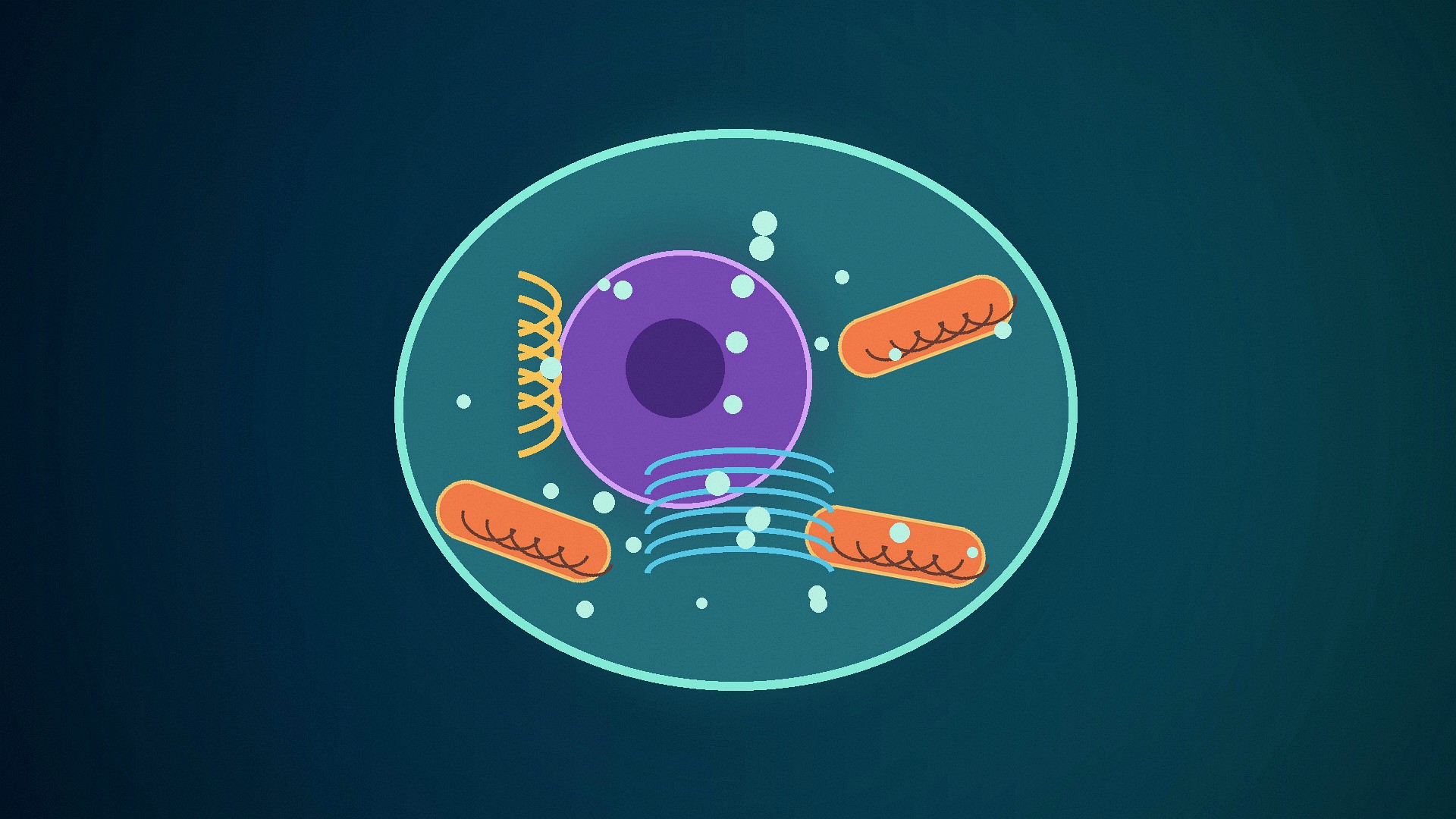
Eukaryotic cells divide essential tasks among membranes, organelles, the cytoskeleton and the cytosol, creating a highly organized chemical system.[5]
Key takeaways
- All cells use a plasma membrane, genetic information and ribosomes, but eukaryotic cells contain a nucleus and membrane-enclosed organelles.
- Organelles create specialized chemical environments for processes such as energy conversion, protein processing and degradation.
- The cytoskeleton organizes cell shape, transport and movement and works with membranes rather than acting as a static scaffold.
In this article
- What all cells have in common
- The plasma membrane
- The nucleus and genetic control
- Endoplasmic reticulum and Golgi apparatus
- Mitochondria, chloroplasts and energy
- Lysosomes, peroxisomes and cellular recycling
- Plant, animal and prokaryotic cells are organized differently
- Protein trafficking connects the endomembrane system
- The cytoskeleton provides structure, transport and force
- Organelles cooperate in metabolism and signaling
- Prokaryotic cells are simpler, not unorganized
What all cells have in common
Cells are the fundamental units of living organisms. Despite enormous diversity, all known cells maintain a boundary membrane, store hereditary information, use ribosomes to make proteins and carry out networks of chemical reactions that sustain life.
Biologists broadly distinguish prokaryotic cells, which lack a membrane-bound nucleus, from eukaryotic cells, which compartmentalize many functions inside membrane-enclosed organelles. Animals, plants, fungi and protists are eukaryotes.[4]
The plasma membrane
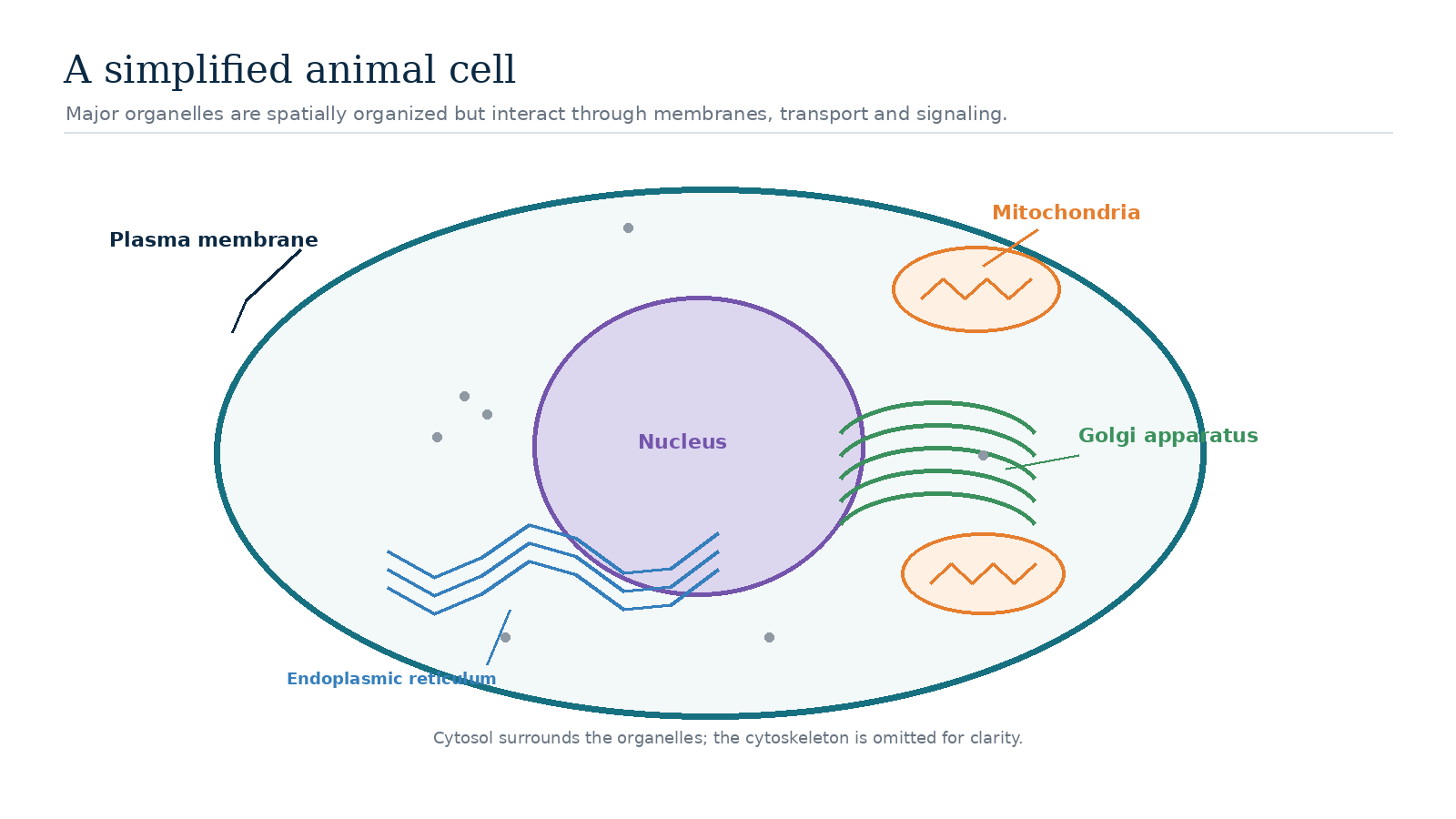
The plasma membrane is mainly a lipid bilayer containing many proteins. It separates the cell from its surroundings while allowing selective exchange. Transporters and channels move ions and molecules, receptors detect signals, enzymes catalyze reactions, and adhesion proteins connect cells to neighbors or extracellular structures.
Because membranes are dynamic, cells can change their surface composition, bend membranes into vesicles and fuse internal compartments. These properties are essential for signaling, nutrient uptake and secretion.
The nucleus and genetic control
In eukaryotes, most genomic DNA is stored in the nucleus. DNA is packaged with proteins into chromatin and organized into chromosomes. The nucleus is the site of DNA replication and much RNA synthesis, while nuclear pores regulate traffic between the nucleus and cytoplasm.
Gene expression is not controlled by a single master switch. Cells regulate which genes are transcribed, how RNA is processed, how long molecules persist and how proteins are modified or degraded.
Endoplasmic reticulum and Golgi apparatus
The endoplasmic reticulum, or ER, forms an extensive membrane network. Ribosomes attached to rough ER synthesize many proteins destined for secretion, membranes or particular organelles. Smooth ER participates in lipid metabolism, calcium storage and other specialized functions.
Proteins and lipids can move from the ER to the Golgi apparatus in transport vesicles. The Golgi modifies and sorts many of these molecules before directing them toward the cell surface, lysosomes or other destinations.
Mitochondria, chloroplasts and energy
Mitochondria generate much of the ATP used by eukaryotic cells through oxidative metabolism. They have their own small genomes and double membranes, reflecting an evolutionary history that traces to ancient symbiosis.[3]
Plant and algal cells also contain chloroplasts, where photosynthesis converts light energy into chemical energy. Chloroplasts likewise possess their own DNA and complex internal membranes.
Lysosomes, peroxisomes and cellular recycling
Lysosomes contain acid-dependent enzymes that digest macromolecules and material delivered by endocytosis or autophagy. This allows cells to recycle building blocks and remove damaged components without exposing the rest of the cytoplasm to the same chemical conditions. Peroxisomes carry out specialized oxidative reactions, including steps in fatty-acid metabolism, and contain enzymes that control reactive oxygen chemistry.[1]
These compartments illustrate why membrane boundaries matter. A eukaryotic cell can maintain different pH values, ion concentrations and reaction pathways in neighboring spaces, then move selected molecules between them using transport proteins and vesicles.[2]
Plant, animal and prokaryotic cells are organized differently
Animal and plant cells are both eukaryotic, meaning their DNA is enclosed in a nucleus and many functions occur in membrane-bound organelles. Plant cells additionally have a cellulose-rich cell wall, chloroplasts in photosynthetic tissues and typically a large central vacuole. Animal cells lack chloroplasts and rigid cell walls but share core structures such as mitochondria, endoplasmic reticulum, Golgi apparatus and cytoskeleton.
Bacteria and archaea are prokaryotes and do not have a membrane-bound nucleus. Their genomes occupy a nucleoid region, and they use different organizational strategies to carry out many of the same fundamental tasks: storing information, making proteins, generating energy and maintaining a boundary with the environment. Compare these groups in our guide to bacteria, archaea and viruses.
Protein trafficking connects the endomembrane system
Proteins destined for secretion, the plasma membrane or many endomembrane compartments are synthesized on ribosomes associated with the rough endoplasmic reticulum. They enter the ER lumen or membrane, undergo folding and quality control, and can be packaged into transport vesicles that move to the Golgi apparatus. The Golgi modifies and sorts cargo for delivery to the cell surface, lysosomes or other destinations.[1]
Other proteins are made on free ribosomes and contain molecular targeting signals that direct them to the nucleus, mitochondria, peroxisomes or other locations. Selective trafficking lets one cell maintain many specialized chemical environments while still coordinating them as a single system.[1]
The cytoskeleton provides structure, transport and force
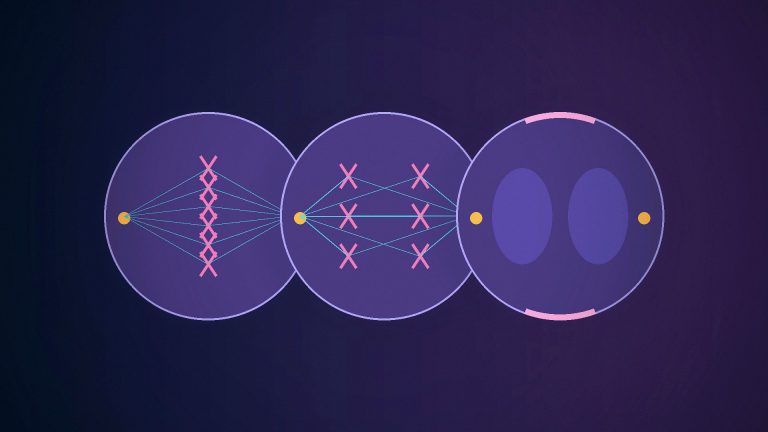
Microtubules, actin filaments and intermediate filaments form the cytoskeleton. These polymers help determine cell shape, position organelles and provide tracks for motor proteins that carry vesicles and other cargo. Microtubules also form the mitotic spindle and the internal framework of cilia and flagella; actin networks support the cell cortex and generate force during migration and cytokinesis.[5]
The cytoskeleton is therefore dynamic rather than a rigid skeleton. Filaments are continually assembled, disassembled and reorganized in response to signals, allowing cells to change shape, divide and move material over distances that would be inefficient by diffusion alone.[5]
Organelles cooperate in metabolism and signaling
Cellular functions usually cross compartment boundaries. Mitochondria exchange metabolites with the cytosol and physically contact the ER. Calcium signals can pass between organelles. Lipids synthesized in the ER are distributed to other membranes, and damaged material can be captured by autophagy pathways and delivered to lysosomes. The cell is therefore better pictured as an interacting system of compartments than as a bag containing independent parts.[2]
Prokaryotic cells are simpler, not unorganized
Bacteria and archaea lack a membrane-bound nucleus and the classic endomembrane system, but their interiors are still highly organized. DNA occupies a nucleoid region, ribosomes are distributed through the cytoplasm, membrane proteins create energy-converting surfaces, and many species build specialized protein structures or internal membrane systems. Some bacteria position chromosomes, enzymes and division machinery at specific locations using cytoskeletal proteins. The difference from a eukaryotic cell is therefore one of architecture and compartment type, not an absence of spatial organization.
Cell size also shapes organization. Most cells remain microscopic because diffusion and transport become harder as volume increases faster than surface area. Eukaryotic compartmentalization and cytoskeletal transport help larger cells move molecules efficiently over longer intracellular distances.