Human evolution was a branching process involving many hominin populations, changing anatomy, behavior, technology and repeated migrations over millions of years.
Key takeaways
- Humans did not evolve from modern chimpanzees; humans and other living apes share earlier common ancestors.
- The hominin fossil record shows a branching evolutionary tree rather than a single ladder of progress.
- Fossils, archaeology, genetics and geochronology provide complementary evidence about human origins and dispersal.
In this article
- A branching history, not a straight line
- Bipedalism came early
- Brains, diets and technology
- The genus Homo and dispersal
- Human traits evolved as a mosaic
- Ancient DNA revealed recent interbreeding
- Homo sapiens emerged in Africa and later dispersed widely
- How fossils, archaeology and genetics are combined
- Dating fossils and archaeological contexts
- Human evolution did not stop with the origin of our species
A branching history, not a straight line
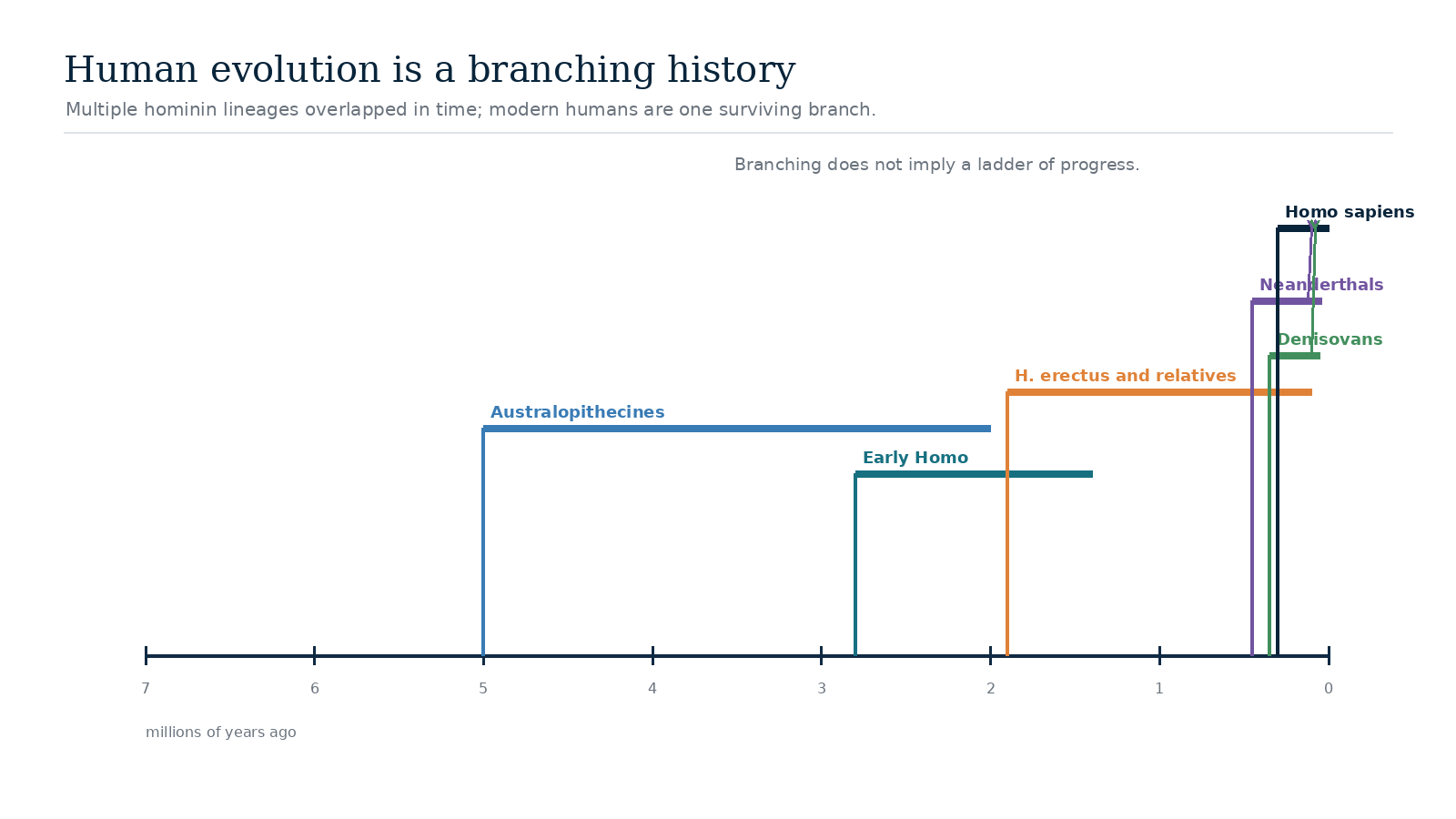
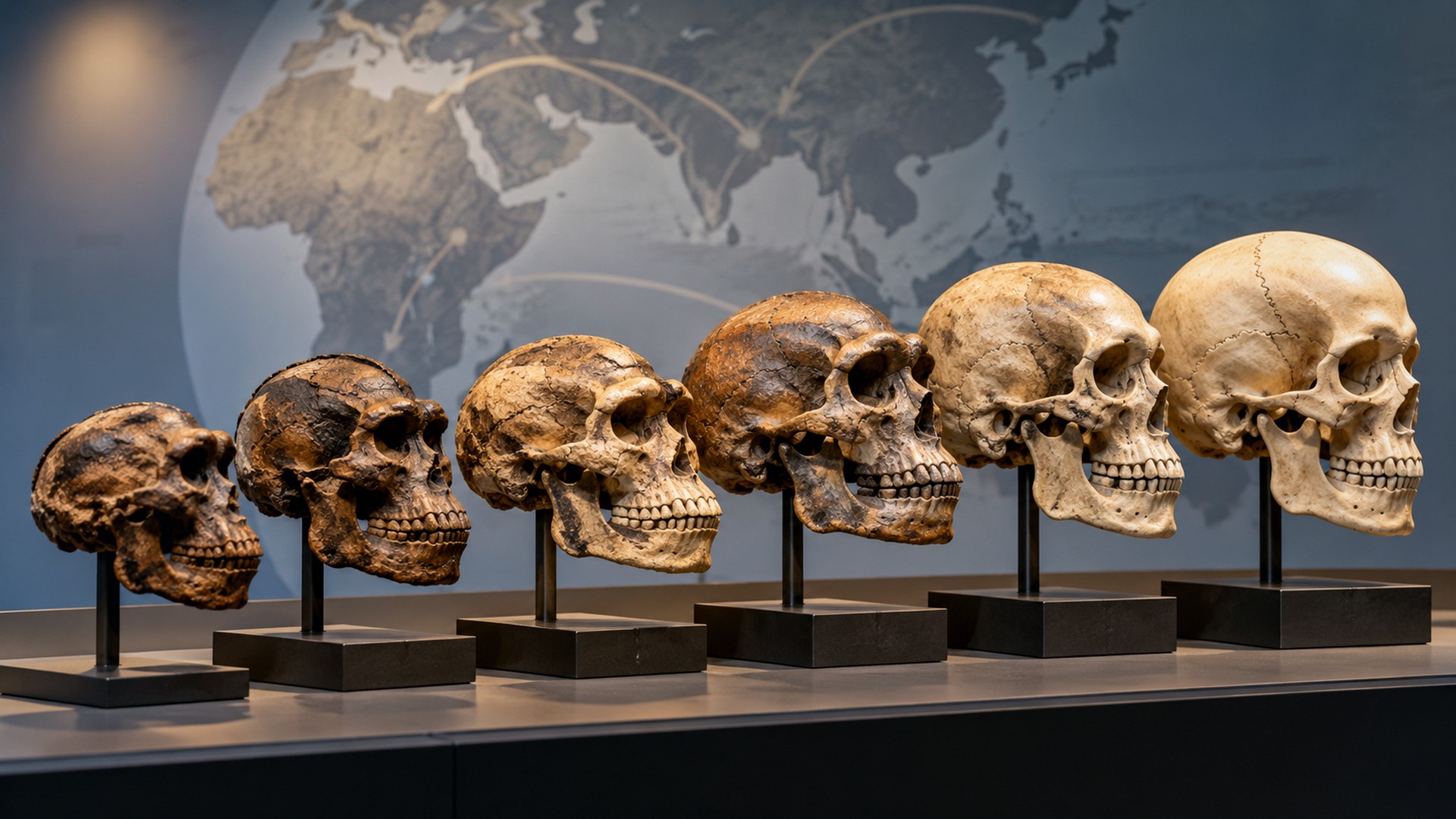
Human evolution is often illustrated as a march from an ape-like ancestor toward modern humans. That image is misleading. Evolution produces branching populations, and several hominin species sometimes lived at the same time. Some lineages ended without descendants, while others contributed to later populations.
Modern humans are primates and share common ancestors with other living apes. We did not descend from any modern chimpanzee or gorilla species. The human and chimpanzee lineages diverged from a shared ancestral population millions of years ago.
Bipedalism came early
Walking habitually on two legs is one of the earliest major features associated with hominin evolution. Fossils show changes in the pelvis, femur, spine and foot that reflect increasing commitment to bipedal locomotion. These changes appeared long before the very large brains characteristic of later Homo.
Bipedalism likely altered how hominins moved through mixed environments and freed the hands from a primary locomotor role, but scientists continue to investigate why it evolved and how different early species combined climbing with ground travel.
Brains, diets and technology
Over time, some hominin lineages evolved larger brains and changes in face and teeth. Stone tools provide evidence of behavior that does not fossilize directly. Tool traditions became more varied and elaborate, although simple technology should not be treated as evidence of simple cognition.
Food processing, meat consumption, plant use, cooking and ecological flexibility all became important in human evolution. These changes interacted with social behavior rather than following a single universal sequence.
The genus Homo and dispersal
Species assigned to the genus Homo appeared in Africa and later expanded into Eurasia. Homo erectus and related populations were among the first hominins to disperse widely. Much later, Neanderthals and Denisovans occupied parts of Eurasia while Homo sapiens evolved in Africa.
Human populations repeatedly moved, mixed and replaced one another. Ancient DNA has shown that the history was not a clean succession of isolated species. Many living people carry small proportions of DNA inherited from Neanderthal or Denisovan populations.
Human traits evolved as a mosaic
Features associated with modern humans appeared at different times rather than in a fixed ladder of progress. Habitual bipedalism evolved millions of years before the large average brain size seen in later members of Homo. Stone tools predate Homo sapiens, and different technologies overlapped for long periods. Changes in body form, diet, social behavior and material culture therefore need to be studied separately before they are combined into a broader evolutionary history.[2]
This mosaic pattern also means that a fossil with one apparently “modern” feature can retain other traits found in earlier populations. Species names are useful scientific hypotheses about relationships, but the fossil record does not consist of neatly separated steps leading toward a predetermined endpoint.[3]
Ancient DNA revealed recent interbreeding
Genetic evidence transformed the study of relatively recent human evolution. DNA recovered from Neanderthal and Denisovan remains showed that these groups were not simply replaced without interaction. Populations of Homo sapiens interbred with other human lineages after dispersing from Africa, and many people alive today carry small proportions of ancestry inherited from those encounters. The amount and distribution vary among populations because migration and interbreeding happened at different times and places.[1]
Ancient DNA is especially powerful when combined with archaeology and fossils, but it has limits. DNA degrades over time and is preserved far better in some climates than others. A genetic lineage is also not automatically identical to a named fossil species. Researchers therefore compare several kinds of evidence rather than expecting one dataset to supply the entire family tree.
Homo sapiens emerged in Africa and later dispersed widely
Fossil and genetic evidence places the origin of Homo sapiens in Africa, with early populations showing geographic and anatomical diversity rather than appearing as a single uniform group in one instant. Later dispersals carried people into Eurasia and eventually to Australia and the Americas. These movements involved repeated population expansions, contractions and contacts with other human lineages. Modern human diversity is therefore the result of both deep African population history and more recent migration and gene flow.
How fossils, archaeology and genetics are combined
Human-origins research draws on several records that preserve different parts of the past. Fossils reveal anatomy, growth and sometimes injury; footprints preserve locomotion; stone tools and cut marks record behavior; isotopes can provide clues about diet, mobility and environment. Stratigraphy and radiometric or paleomagnetic dating place discoveries in time, while ancient and modern DNA can test relationships among populations.[2][4]
No single record is complete. Fossils are unevenly preserved, archaeological behavior can be difficult to interpret, DNA survives far better in some environments than others, and genetic models depend on assumptions about population size and migration. Strong reconstructions therefore rely on agreement among independent methods rather than treating one specimen or one genome as a complete family tree.[2][3]
Dating fossils and archaeological contexts
Evolutionary timelines are assembled from more than the shape of fossils. Researchers combine stratigraphy with radiometric dating of suitable volcanic layers, paleomagnetic evidence, archaeology and the geological context in which specimens are found. Each method has a range of materials and ages for which it works best, and dates normally carry uncertainty rather than identifying an exact calendar year. A fossil can therefore be placed within a well-supported interval without implying that it represents a direct ancestor of every later human population. Context is also essential: a bone removed from its sedimentary setting can lose much of the evidence needed to interpret its age and environment.[2]
Human evolution did not stop with the origin of our species
Homo sapiens continues to evolve. Natural selection has acted on traits related to diet, infectious disease, skin pigmentation, high-altitude physiology and other environments, while migration and population mixing continually reshape genetic variation. Most human genetic variation is shared broadly across populations, and boundaries between populations are gradual rather than biological divisions into discrete types.[5]