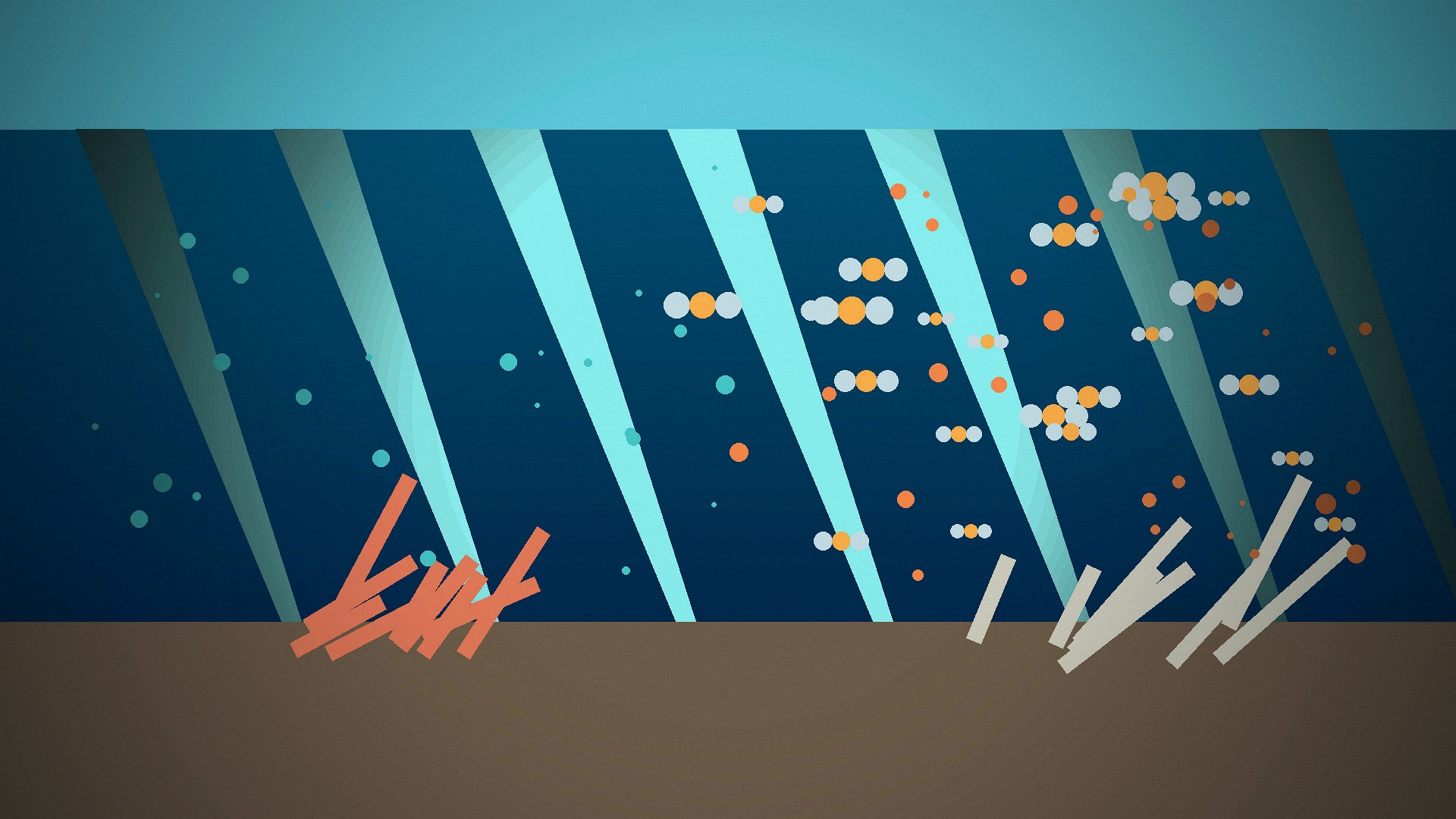
As the ocean absorbs atmospheric carbon dioxide, seawater chemistry shifts toward lower pH and reduced carbonate availability, affecting many marine organisms.
Key takeaways
- Ocean acidification is a long-term decline in seawater pH driven primarily by uptake of human-produced atmospheric carbon dioxide.
- Added carbon dioxide forms carbonic acid, increasing hydrogen ions while reducing carbonate-ion availability.
- Calcifying organisms such as corals and some shellfish can face greater difficulty building and maintaining calcium-carbonate structures.
In this article
- The ocean is part of the carbon cycle
- Carbonate chemistry: why pH and carbonate both change
- Calcification and aragonite saturation
- Reefs and food webs
- Coastal waters can change faster than the open ocean
- Monitoring the carbonate system
- Organisms may acclimate or adapt, but not all at the same rate
- Acidification can matter to fisheries and aquaculture
- Why exposure differs among habitats
- Future change depends on carbon-dioxide emissions
The ocean is part of the carbon cycle
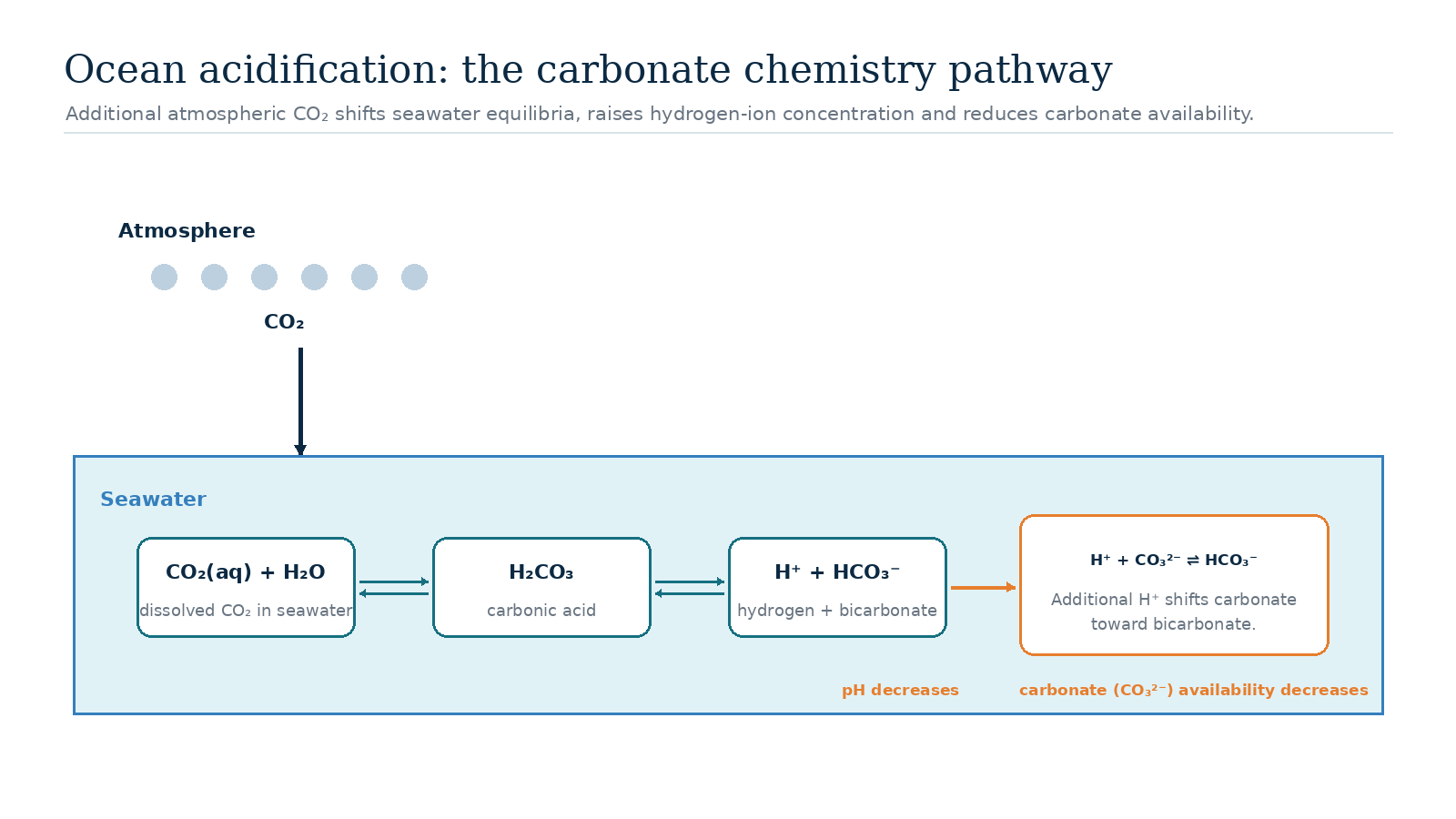
The atmosphere and ocean continuously exchange carbon dioxide. When atmospheric CO2 increases, more of the gas dissolves into surface seawater. This absorption slows the buildup of CO2 in the atmosphere but changes marine chemistry.
NOAA estimates that the ocean absorbs a substantial share of human carbon-dioxide emissions. The resulting chemical shift occurs globally, although local conditions such as temperature, circulation, freshwater input and biological activity influence the rate of change.
Carbonate chemistry: why pH and carbonate both change
Ocean acidification is often summarized as a fall in pH, but the change involves the entire carbonate system. Dissolved carbon dioxide reacts with water and shifts chemical equilibria toward more hydrogen ions and bicarbonate. As hydrogen-ion concentration rises, some carbonate ions are converted to bicarbonate, leaving less carbonate available for other reactions.[1]
Average surface-ocean pH has fallen by about 0.1 unit since the beginning of the industrial era. Because the pH scale is logarithmic, that represents roughly a 30% increase in hydrogen-ion concentration even though average seawater remains alkaline, near pH 8 rather than below 7. “Acidification” means a shift toward greater acidity, not that the open ocean has become an acidic solution in the everyday sense.[1]
Calcification and aragonite saturation
Corals, pteropods, oysters, clams and many other organisms build shells or skeletons from calcium carbonate. A useful measure for these organisms is the saturation state of calcium-carbonate minerals such as aragonite. As dissolved carbon dioxide increases and carbonate-ion availability falls, aragonite saturation generally declines, making the chemical environment less favorable for forming and maintaining some calcium-carbonate structures.[2][5]
Biological responses are not uniform. Species, life stage, food supply, temperature, oxygen and local adaptation all influence sensitivity. Some organisms can regulate the chemistry at the site where they calcify, while others experience slower growth or higher energetic costs. Acidification therefore changes probabilities and physiological constraints rather than producing one identical response in every species.[5]
Reefs and food webs
For coral reefs, acidification can reduce reef-building rates at the same time warming increases bleaching risk. If erosion outpaces calcification, the physical reef framework can weaken even when some living corals remain.
Changes to plankton, shellfish or habitat-forming species can propagate through food webs and fisheries. Coastal communities may face ecological and economic consequences where aquaculture or wild harvests depend on sensitive species.
Coastal waters can change faster than the open ocean
Global uptake of fossil-fuel carbon dioxide drives the long-term trend, but coastal chemistry is also shaped by freshwater, upwelling, respiration, nutrient inputs and decomposition. Productive estuaries can experience large daily and seasonal swings in carbon dioxide and pH, and upwelling can bring naturally carbon-rich deeper water onto continental shelves. These local processes can temporarily intensify or partly offset the global signal.[3]
That variability is why coastal monitoring needs context. A single pH measurement cannot reveal whether a site is undergoing a long-term shift, a seasonal cycle or a short biological pulse. Time series and measurements of several carbonate-system variables provide a more reliable picture.[3]
Monitoring the carbonate system
Researchers commonly measure pH together with total alkalinity, dissolved inorganic carbon or the partial pressure of carbon dioxide. Temperature and salinity are also needed because they affect chemical equilibria. From combinations of these observations, scientists can calculate carbonate-ion concentration and mineral saturation states, then connect chemical change to biological observations.[2][3]
Long-term records from ships, moorings, autonomous sensors and coastal stations help distinguish natural variability from persistent trends. In aquaculture regions, real-time chemistry measurements can also guide operational decisions, for example by identifying periods when intake water is unusually corrosive to sensitive shell-forming larvae.[5]
Organisms may acclimate or adapt, but not all at the same rate
Some marine organisms can adjust physiology when carbonate chemistry changes, and populations exposed to naturally variable conditions may differ in sensitivity from populations in more stable water. Evolutionary adaptation is also possible when heritable variation affects survival and reproduction. Those responses are important areas of research, but they do not imply that ecosystems will be unaffected. Species interact through food webs, habitat formation and competition, so winners and losers can reorganize communities even when no single species disappears completely.
Acidification can matter to fisheries and aquaculture
Biological effects vary among species and life stages, but sensitive shell-forming larvae can be especially vulnerable when carbonate saturation is low. Hatcheries in some coastal regions already monitor intake-water chemistry so they can avoid or treat periods of corrosive water. These practical responses do not remove the global driver, but they show how chemical monitoring can support adaptation in fisheries and aquaculture while emissions reductions address the long-term cause.[5]
Why exposure differs among habitats
Marine organisms do not experience one uniform “ocean pH.” Deep water, upwelling zones, estuaries and tide pools can differ greatly in carbon dioxide, temperature and alkalinity. Photosynthesis can raise local pH during daylight, while respiration and decomposition push it lower. Organisms living in naturally variable habitats may therefore encounter a wider range of carbonate conditions than open-ocean species, but natural variability does not cancel the long-term shift caused by additional atmospheric carbon dioxide.[3]
This spatial variation matters when experiments are designed or when local monitoring data are compared. A result from one species and one laboratory treatment cannot be applied automatically to an entire ecosystem. Researchers increasingly study acidification together with warming, oxygen loss and food availability because organisms respond to combinations of environmental stressors.
Future change depends on carbon-dioxide emissions
Ocean acidification is directly linked to the amount of carbon dioxide added to the atmosphere. The IPCC assesses that continued greenhouse-gas emissions will drive further ocean warming and acidification, while deeper emissions reductions limit the magnitude of future chemical change.[4]
Local actions can still matter. Reducing nutrient pollution, protecting habitats and improving water-quality monitoring can lower additional stress on coastal ecosystems and help fisheries or hatcheries respond to short-term corrosive conditions. Those measures complement rather than replace reductions in carbon-dioxide emissions, because the global chemical driver cannot be removed by local management alone.[5]