Photosynthesis captures light energy, uses it to generate ATP and NADPH, and then fixes carbon dioxide into organic molecules that can support growth.
Key takeaways
- Light-dependent reactions in thylakoid membranes convert absorbed light into ATP and NADPH while releasing oxygen from water.
- The Calvin–Benson cycle uses ATP and NADPH to incorporate carbon dioxide into organic molecules.
- Photosynthesis links solar energy to much of Earth’s food web and oxygen cycle.
In this article
- What photosynthesis actually does
- Light absorption and photosystems
- Electron transport builds a proton gradient
- How NADPH is produced
- The Calvin–Benson cycle fixes carbon
- Why photosynthesis matters beyond plants
- Photoprotection: using light without damaging the photosystems
- Photorespiration and the limits of Rubisco
- What controls the rate of photosynthesis in a real leaf
What photosynthesis actually does
Photosynthesis is often summarized as plants using sunlight to make sugar, but the real process is a chain of energy conversions. In plants and algae, light energy is captured by pigments and converted into chemical forms that cells can use. Carbon dioxide is then incorporated into organic molecules, while oxygen is released as a by-product of splitting water.
The overall process takes place in chloroplasts. Inside each chloroplast is a system of flattened membranes called thylakoids, surrounded by a fluid compartment called the stroma. This organization separates the light-dependent reactions from the carbon-fixing reactions while allowing the products of one stage to feed the next.
Light absorption and photosystems
Chlorophyll and accessory pigments absorb photons. The energy does not simply become heat: it is transferred through pigment-protein complexes until it reaches reaction centers in two major systems, Photosystem II and Photosystem I. At these centers, light energy drives electrons into higher-energy states.
Photosystem II replaces its lost electrons by extracting them from water. That reaction releases oxygen, protons and electrons. The oxygen can diffuse out of the plant and contributes to the atmospheric oxygen used by aerobic organisms.
Electron transport builds a proton gradient
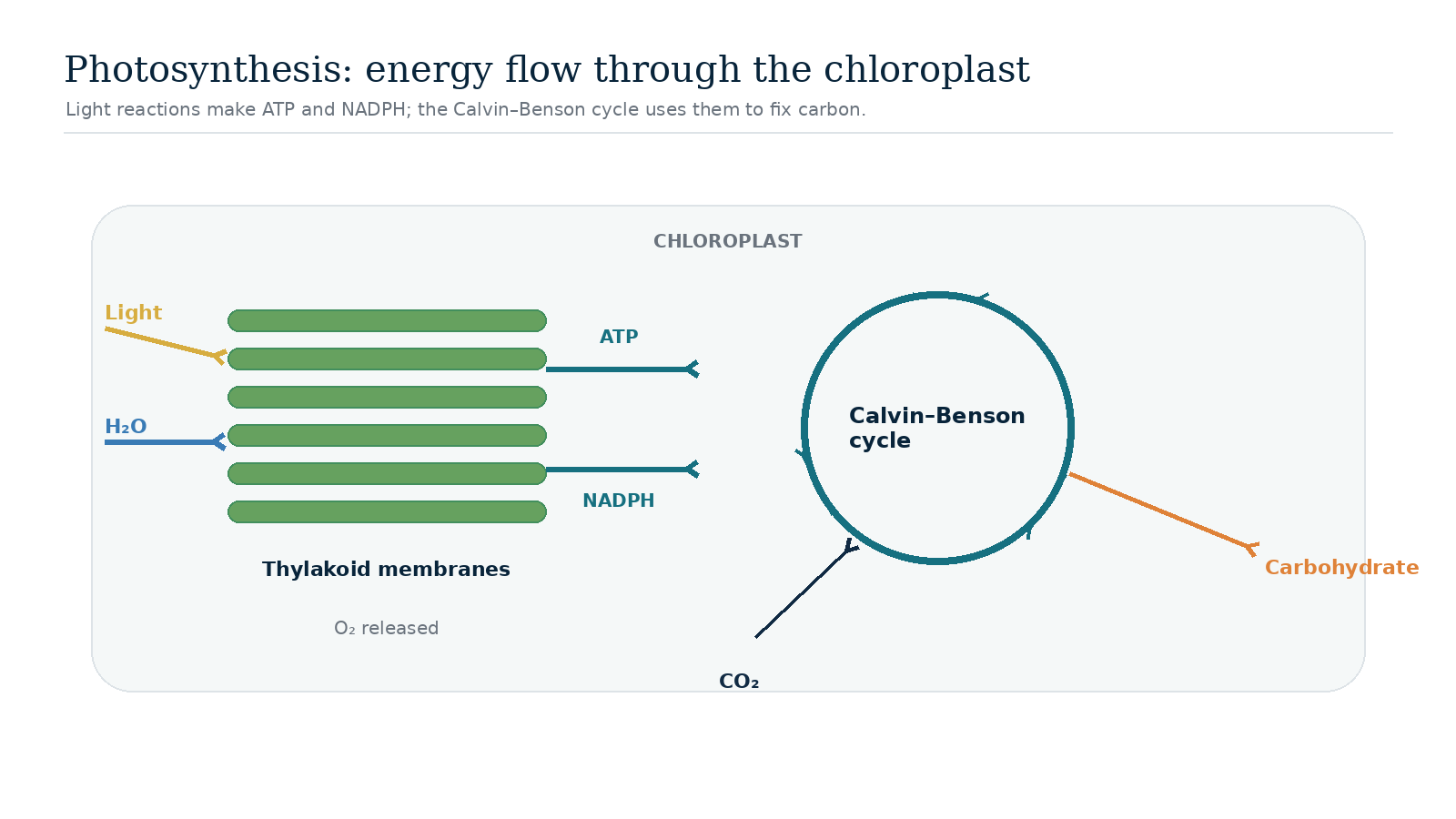
Excited electrons travel through a chain of carriers embedded in the thylakoid membrane. Their movement is coupled to the transfer of protons into the thylakoid interior. This creates an electrochemical gradient: protons become more concentrated on one side of the membrane than the other.
ATP synthase provides a route for protons to flow back across the membrane. The energy released by that flow is used to produce ATP from ADP and inorganic phosphate. This principle, called chemiosmosis, is also central to energy production in mitochondria.
How NADPH is produced
After moving through the first part of the electron-transport chain, electrons reach Photosystem I, where another photon boosts their energy. They are then used to reduce NADP+ to NADPH. ATP and NADPH are the principal energy and reducing-power products of the light reactions.
The phrase “dark reactions” is sometimes used for the next stage, but it can be misleading. Carbon fixation does not require photons directly, yet it depends on ATP and NADPH produced by the light reactions and is closely integrated with the plant’s overall metabolism.
The Calvin–Benson cycle fixes carbon
In the stroma, the Calvin–Benson cycle incorporates carbon dioxide into organic molecules. The enzyme Rubisco catalyzes the addition of carbon dioxide to ribulose-1,5-bisphosphate. The resulting unstable product rapidly forms smaller molecules that are processed using ATP and NADPH.
Some of the resulting three-carbon molecules leave the cycle and can contribute to the synthesis of sugars, starch, amino acids and other compounds. Most are used to regenerate the carbon-accepting molecule so that the cycle can continue.
Why photosynthesis matters beyond plants
Photosynthesis supplies the chemical energy that supports most ecosystems either directly or indirectly. Plants, algae and photosynthetic microorganisms form the base of many food webs. The process also exchanges enormous amounts of carbon dioxide and oxygen with the atmosphere and oceans.
Photosynthetic efficiency is influenced by light, temperature, carbon dioxide availability, water status and the biochemistry of the plant. Research on these constraints is important in agriculture, ecology and climate science because photosynthesis sits at the intersection of food production, carbon cycling and ecosystem productivity.
Photoprotection: using light without damaging the photosystems
Absorbing more light does not always increase carbon fixation. When light energy arrives faster than the photosynthetic machinery can use it, chloroplasts must dissipate the excess safely. Plants adjust antenna complexes, change electron flow and use non-photochemical quenching to release part of the absorbed energy as heat. These protective responses help limit the formation of reactive oxygen species that can damage photosystem proteins and membranes.[4]
Photoprotection explains why photosynthetic performance depends on balance rather than maximum light capture. A leaf in full sun, drought or temperature stress may deliberately reduce photochemical efficiency to protect its machinery. The C4 and CAM pathways described below solve a different problem: they alter how carbon dioxide is supplied to Rubisco, helping some plants reduce photorespiration or water loss in particular environments.[5]
Photorespiration and the limits of Rubisco
The enzyme Rubisco begins carbon fixation by adding carbon dioxide to ribulose-1,5-bisphosphate. Rubisco can also react with oxygen, especially when leaves are warm or carbon dioxide inside the leaf is scarce. That competing reaction starts photorespiration, a pathway that consumes energy and releases some previously fixed carbon. Photorespiration is not simply a useless mistake—it is tied to plant metabolism and stress responses—but it reduces the efficiency with which many plants convert absorbed light into net carbon gain.[1]
Plants have evolved several ways to manage this problem. C4 plants, including maize and sugarcane, first concentrate carbon dioxide in one set of cells before delivering it to Rubisco in another. CAM plants, including many cacti and succulents, separate carbon uptake and carbon fixation by time: stomata open mainly at night, reducing water loss, and stored carbon is used during the day. These pathways help plants succeed in hot, bright or water-limited environments, although they require extra biochemical steps.[2]
What controls the rate of photosynthesis in a real leaf
Light intensity is only one control. Carbon-dioxide availability, temperature, water supply, leaf nitrogen, stomatal opening and the amount of photosynthetic machinery all matter. At low light, additional photons can strongly increase carbon fixation. At high light, another factor can become limiting, and excess absorbed energy has to be safely dissipated to prevent damage to the photosystems.
This is why photosynthesis is best understood as a coordinated energy-conversion system rather than a single equation. The familiar summary—carbon dioxide plus water producing carbohydrate and oxygen—describes the net outcome. Inside a leaf, dozens of coupled reactions regulate electron flow, proton gradients, ATP production, redox balance and carbon metabolism while the plant responds continuously to its environment.[3]