
The periodic table organizes elements by atomic number so that repeating patterns in electron structure and chemical behavior become visible.
Key takeaways
- Elements are ordered by atomic number, the number of protons in the nucleus.
- Rows are periods and columns are groups; elements in the same group often share important chemical characteristics.
- Periodic trends such as atomic size, ionization energy and electronegativity arise from electron structure and nuclear charge.
In this article
- Why the table is periodic
- Periods, groups and blocks
- Metals, nonmetals and metalloids
- Atomic size, ionization energy and electronegativity
- Electron configuration explains the repeating pattern
- Atomic weights reflect isotopes
- Using periodic position to predict chemical behavior
- Where simple periodic trends break down
- Valence electrons, oxidation states and reactivity
- The table is a model that has been refined with atomic physics
Why the table is periodic
The periodic table is more than a list of chemical elements. Its arrangement reveals recurring patterns in chemical behavior. Elements are ordered by atomic number, which equals the number of protons in the nucleus. As atomic number increases, electron configurations develop in systematic ways.
Chemical properties repeat because the arrangement of outer electrons repeats. This is why elements placed in the same column can behave similarly even though their atoms have different masses.
Periods, groups and blocks
Horizontal rows are called periods. Moving across a period adds protons to the nucleus and electrons to the atom while filling related electron shells or subshells. Vertical columns are called groups. Group 1 contains the alkali metals, group 17 the halogens and group 18 the noble gases.
The table is also divided into s, p, d and f blocks according to the type of atomic orbital being filled. The d block contains the transition metals, while the lanthanides and actinides are commonly displayed below the main body for compactness.
Metals, nonmetals and metalloids
Most elements are metals. Metals generally conduct heat and electricity well and often form positive ions, although their properties vary widely. Nonmetals occupy much of the upper-right portion of the table and include gases, brittle solids and the liquid bromine.
Elements near the traditional boundary between metals and nonmetals are sometimes described as metalloids because they show intermediate or mixed properties. The category is useful in teaching but does not have one universally applied boundary.
Atomic size, ionization energy and electronegativity
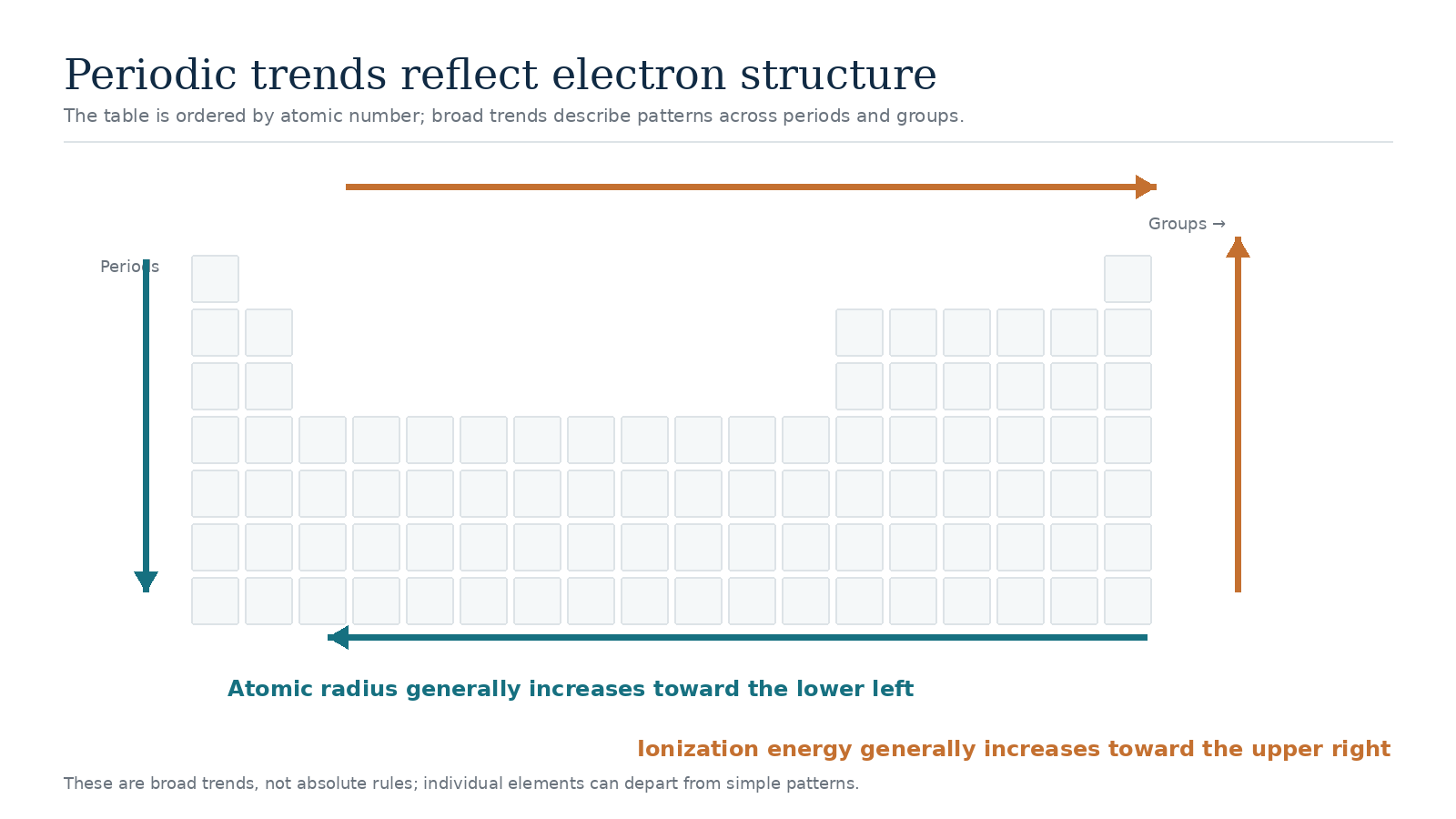
Atomic radius generally decreases from left to right across a period because increasing nuclear charge attracts the electron cloud more strongly while the principal occupied shell remains broadly similar. Radius generally increases down a group as additional electron shells are added. First ionization energy—the energy required to remove an electron—shows the opposite broad tendency, increasing across a period and decreasing down a group.[1][2]
Electronegativity describes an atom’s tendency to attract shared electrons in a chemical bond. It generally rises toward the upper-right part of the table for elements to which the common scales are applied. These directions are useful trends, not inviolable laws: subshell energies, electron pairing, shielding and relativistic effects create important exceptions.[4]
Electron configuration explains the repeating pattern
The table is ordered by atomic number, but the repeating chemical pattern comes from the way electrons occupy quantum-mechanical shells and subshells. Elements in the same group often have similar outer-electron configurations, which is why they tend to form related ions and bonds. Alkali metals commonly lose one outer electron, while halogens commonly gain or share one electron to approach a filled valence shell.[1]
The s, p, d and f blocks correspond broadly to the type of subshell being filled. This organization places the transition metals in the central d block and the lanthanides and actinides in the f block, which is usually displayed below the main table for compactness even though those elements belong within periods 6 and 7.[2]
Atomic weights reflect isotopes
The number printed in a periodic table is usually a standard atomic weight, not the mass number of one atom. Many elements occur naturally as mixtures of isotopes with different numbers of neutrons, so the listed value reflects their relative abundances in normal terrestrial materials. For elements with no stable isotopes, periodic tables typically show the mass number of a representative or longest-lived isotope instead of a standard atomic weight.[3]
Periodic trends are broad tendencies rather than absolute rules, so measured values and detailed electron configurations remain important when comparing specific elements.
Using periodic position to predict chemical behavior
Periodic position gives chemists a first estimate of likely valence states, bond types and reactivity. Main-group elements in the same group often form related ions because they have similar numbers of valence electrons. Across the transition metals, partially filled d subshells allow several oxidation states, so simple group rules become less reliable. The table is therefore most useful as a map of tendencies that can be checked against measured data and the electronic structure of a specific element or compound.
Where simple periodic trends break down
Periodic position is a powerful first approximation, but measured properties do not change smoothly from one element to the next. Electron pairing, half-filled and filled subshells, oxidation state and relativistic effects can shift ionization energies, sizes and bonding behavior away from a simple arrow drawn across the table. Transition metals are especially likely to show several oxidation states because the energies of their outer s and d electrons can be similar.[4]
For quantitative work, chemists therefore use experimental data and detailed electronic structure rather than relying only on the table’s visual trends. Spectroscopy provides measured energy levels and ionization thresholds, while databases such as the NIST Atomic Spectra Database compile experimental atomic data that reveal both the broad periodic pattern and its exceptions.[5]
Valence electrons, oxidation states and reactivity
For main-group elements, periodic position provides a useful first estimate of the number of valence electrons and therefore of common bonding patterns. Group 1 metals readily form +1 ions, group 2 metals commonly form +2 ions, and halogens often form −1 ions or one covalent bond. Noble gases have filled valence shells and are generally much less reactive under ordinary conditions, although heavier noble gases can form compounds in suitable chemical environments.[1][2]
Transition metals are less easily summarized because the energies of their outer s and d electrons are similar. Many can adopt several oxidation states, and their compounds often show distinctive colors, magnetic properties and catalytic behavior. Periodic position still provides context, but quantitative chemistry requires measured redox potentials, bond energies and electronic structures rather than a simple group rule.
The table is a model that has been refined with atomic physics
The modern periodic table reflects a long shift from arranging elements by observed chemical similarity and atomic mass to ordering them by atomic number. Atomic number provides the fundamental sequence because it counts protons and therefore fixes the identity of the element. Quantum mechanics later explained why electron configurations repeat in a way that produces periodic chemical behavior. The table is therefore both a practical reference and a compact model of atomic structure rather than an arbitrary chart.[1]