Our solar system contains the Sun, eight planets, officially recognized dwarf planets, hundreds of moons and vast populations of smaller bodies.
Key takeaways
- The solar system formed about 4.6 billion years ago from a collapsing cloud of gas and dust.
- The four inner planets are rocky; Jupiter and Saturn are gas giants, while Uranus and Neptune are ice giants.
- Small bodies and moons preserve evidence about solar-system formation and remain major targets of exploration.
In this article
- The Sun is the system’s gravitational center
- How the solar system formed
- The terrestrial planets
- The giant planets
- Dwarf planets and small bodies
- A system still being explored
- Beyond the planets: the Kuiper Belt, Oort Cloud and heliosphere
- The scale of the solar system is difficult to show in one picture
- Moons are worlds in their own right
- The solar system has a dynamic boundary
- Small bodies preserve clues to formation
The Sun is the system’s gravitational center
The solar system is the collection of objects bound primarily by the Sun’s gravity. The Sun contains the overwhelming majority of the system’s mass, so its gravity governs the broad architecture of planetary orbits. The planets travel around it in the same general direction and in orbits that lie close to a common plane.
Our system occupies a small part of the Milky Way galaxy. The Sun and its planets orbit the galactic center, but the gravitational relationships we usually call the solar system are dominated locally by the Sun.
How the solar system formed

The leading model begins about 4.6 billion years ago with a cloud of gas and dust. As part of the cloud collapsed under gravity, conservation of angular momentum caused material to flatten into a rotating disk. The young Sun formed at the center while solid particles in the disk collided and accumulated into larger bodies.
Temperature differences across the disk influenced what could condense. Close to the Sun, heat favored rock and metal. Farther out, ices and volatile compounds could remain solid, allowing large planetary cores to grow and capture extensive envelopes of gas.
The terrestrial planets
Mercury, Venus, Earth and Mars are terrestrial planets. They are relatively small, dense worlds with solid surfaces dominated by rock and metal. Their histories differ dramatically despite this shared foundation.
Mercury is airless apart from an extremely tenuous exosphere. Venus has a dense carbon-dioxide atmosphere and intense greenhouse warming. Earth has liquid surface oceans and known life. Mars is cold and dry today, but its geology preserves evidence of ancient water.
The giant planets
Jupiter and Saturn are gas giants dominated by hydrogen and helium. Uranus and Neptune are often called ice giants because models indicate a larger fraction of heavier volatile materials in their interiors. All four possess ring systems and extensive families of moons.
Giant-planet moons are scientifically important worlds in their own right. Europa and Enceladus, for example, show evidence consistent with subsurface oceans, making icy moons major targets in the search for potentially habitable environments.
Dwarf planets and small bodies
Not every round object orbiting the Sun is classified as a planet. The International Astronomical Union recognizes several dwarf planets, including Ceres and Pluto. The system also contains asteroids, comets, meteoroids and trans-Neptunian objects.
These smaller bodies are remnants and products of solar-system evolution. Their compositions and orbits help scientists reconstruct conditions in the early disk and the later migration and interaction of planets.
A system still being explored
Robotic spacecraft have transformed the solar system from points of light into diverse worlds with volcanoes, canyons, storms, rings, oceans, atmospheres and complex chemistry. Yet major questions remain about planetary formation, the distribution of water and organic compounds, and environments that could support life.
Exploration therefore combines astronomy with geology, chemistry, physics and biology. The solar system is both our local cosmic neighborhood and a natural laboratory for understanding planetary systems throughout the galaxy.
Beyond the planets: the Kuiper Belt, Oort Cloud and heliosphere
Neptune is not the physical edge of the Solar System. The Kuiper Belt contains icy worlds and smaller bodies beyond Neptune, including Pluto and other dwarf planets. Comets with short orbital periods often trace their origins to this outer region, while many long-period comets are thought to come from a much more distant, roughly spherical reservoir called the Oort Cloud.[4][5]
The Sun also creates a vast magnetic and particle environment called the heliosphere. The solar wind expands outward until it interacts with the interstellar medium. Spacecraft observations of these boundaries help scientists study how our local stellar environment works and provide context for comparing the Solar System with planetary systems around other stars.
The scale of the solar system is difficult to show in one picture
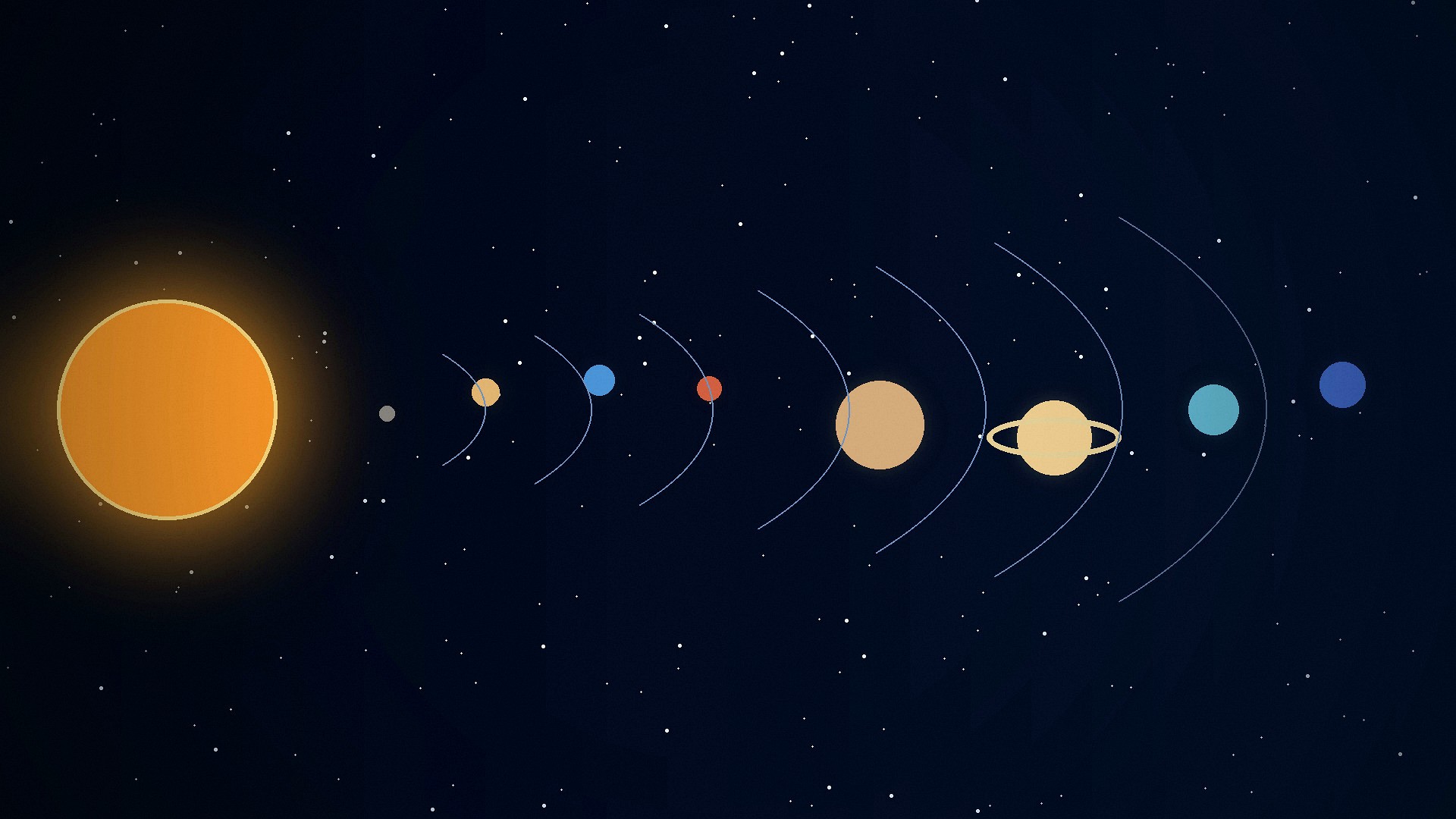
Most illustrations enlarge the planets and compress the distances so that everything can be seen. In reality, the Sun contains more than 99% of the solar system’s mass, while the planets occupy tiny points separated by enormous stretches of space. Earth orbits about one astronomical unit from the Sun—roughly 150 million kilometers—while Neptune averages about 30 astronomical units away.[1]
That scale matters when thinking about travel time, sunlight and temperature. Light takes about eight minutes to reach Earth from the Sun but several hours to reach the outer planets. Spacecraft therefore operate with significant communication delays, and solar energy becomes much weaker with distance because the same amount of radiation spreads over a larger area.
Moons are worlds in their own right
Many of the most geologically interesting bodies are moons. Jupiter’s Io is intensely volcanic; Europa is thought to contain a global ocean beneath an icy shell. Saturn’s Titan has a dense atmosphere and lakes of liquid hydrocarbons, while Enceladus ejects water-rich plumes from a subsurface ocean. These objects broaden the study of planets because they show that internal heating, oceans and complex chemistry can occur far from the Sun.[2]
The solar system has a dynamic boundary
The Sun emits a continuous flow of charged particles called the solar wind. Its influence creates the heliosphere, a vast bubble in the surrounding interstellar medium. The heliopause marks the region where the solar wind is balanced by the environment beyond it. Voyager 1 and Voyager 2 have crossed this boundary, providing the first direct measurements from interstellar space while still remaining gravitationally bound to the Sun on their long trajectories.[3]
Small bodies preserve clues to formation
Asteroids, comets and Kuiper Belt objects are scientifically valuable because many preserve material that was never assembled into a large planet. Their compositions record temperature, water content and chemical conditions in different parts of the young solar nebula. Collisions also move material between regions: meteorites that fall to Earth can be traced to asteroid families, while comet samples and asteroid-return missions provide laboratory measurements of primitive solar-system material. These objects are therefore not merely debris; they are records of planetary formation and migration.