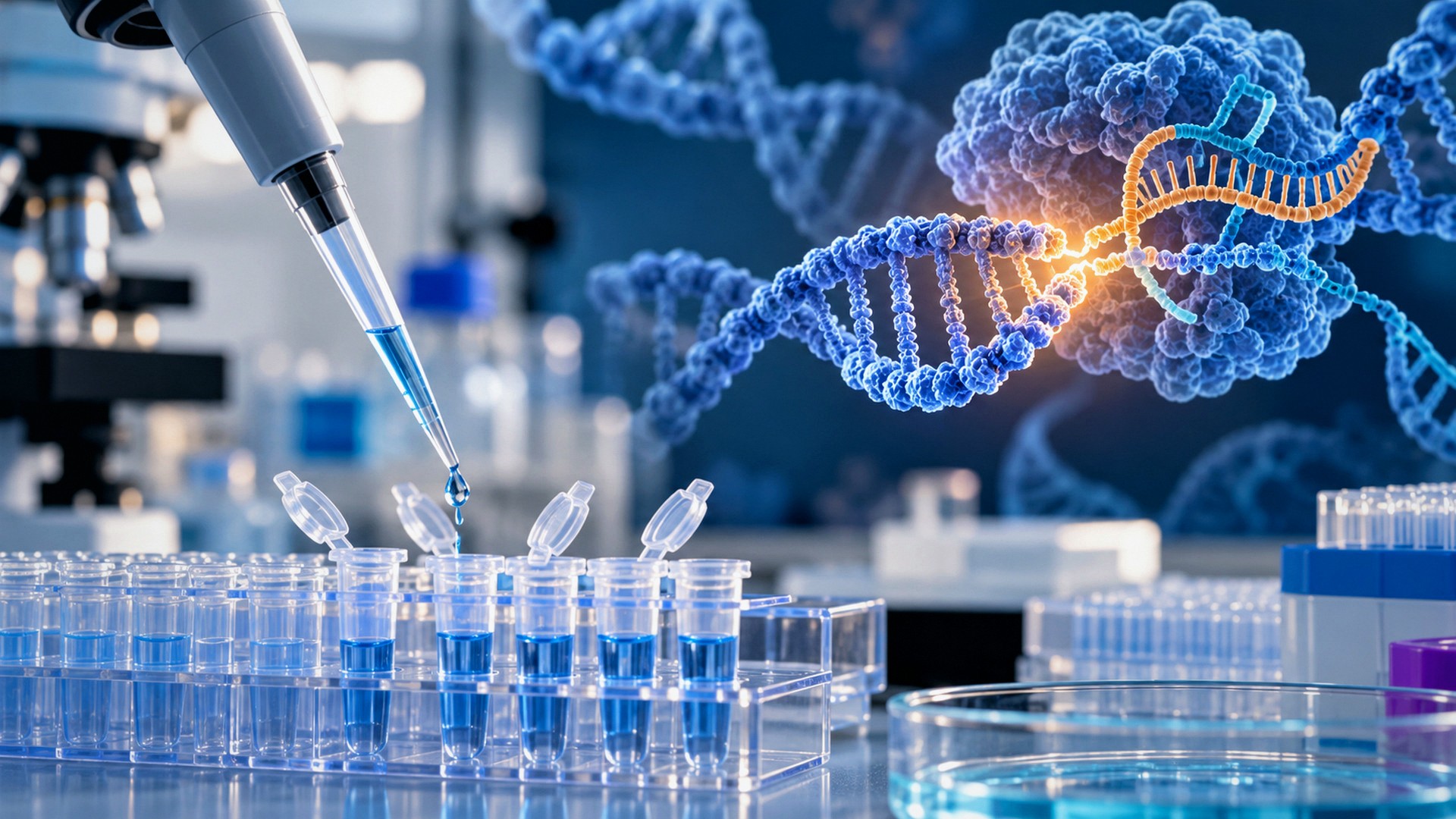
CRISPR-based genome editing uses programmable RNA-guided proteins to target DNA, enabling researchers to disrupt, replace or precisely alter genetic sequences.
Key takeaways
- CRISPR systems originated as microbial defense mechanisms and were adapted into programmable genome-editing tools.
- A guide RNA directs a CRISPR-associated protein to a matching DNA sequence, where the protein can cut or modify the target.
- The biological outcome depends on how the cell repairs or processes the targeted DNA, and precision varies by method and context.
In this article
- From microbial defense to biotechnology
- Targeting DNA with a guide RNA
- Repair determines the edit
- Research, medicine and agriculture
- Delivery is often harder than making the molecular cut
- Accuracy has several dimensions
- Base editing and prime editing change the repair problem
- An edit is not established until the outcome is measured
- Somatic editing, heritable editing and governance
From microbial defense to biotechnology
CRISPR refers to DNA sequences and associated proteins that form part of adaptive defense systems in many bacteria and archaea. Microbes can retain fragments of genetic material from past invaders and use RNA molecules derived from those fragments to help recognize related sequences during later encounters.
Researchers adapted this recognition system into a laboratory tool. Instead of relying on a naturally acquired sequence, they can design a guide RNA that directs a CRISPR-associated protein toward a chosen genetic target.
Targeting DNA with a guide RNA

In the widely used CRISPR-Cas9 system, a guide RNA contains a region complementary to the target DNA. Cas9 scans DNA and can bind when sequence matching occurs next to a short required motif. The protein then cuts both DNA strands near the target.
Target recognition is highly programmable, which is one reason CRISPR became so influential. Designing a guide is generally simpler than engineering a new DNA-binding protein for every target.
Repair determines the edit
A DNA break is not the final edit. Cells activate their own repair pathways after Cas9 cuts the target. End joining can reconnect the broken ends while introducing small insertions or deletions, an outcome that is useful when the goal is to disrupt a gene. Template-directed repair can copy sequence information from a supplied DNA template and make a defined change, although this pathway can be inefficient in many cell types and depends strongly on cellular state.[2]
The same guide-and-target principle can therefore produce very different biological outcomes depending on the nuclease, repair pathway and experimental design. Successful genome editing requires measuring the sequence that remains after repair rather than assuming that cleavage automatically created the intended genotype.[2]
Research, medicine and agriculture
CRISPR is used to study gene function, build disease models, engineer cells and investigate biological pathways. Clinical applications include editing cells outside the body and returning them to a patient, as well as research on direct delivery to tissues.
Plant researchers use genome editing to study traits and develop crops with altered disease resistance, quality or environmental responses. Regulatory treatment varies among jurisdictions and depends on the organism and type of change.
Delivery is often harder than making the molecular cut
A CRISPR system works only if its components reach the right cells and enter the correct cellular compartment. In laboratory cell cultures, researchers can introduce RNA and protein directly. In an organism, delivery may require lipid nanoparticles, engineered viruses or other carriers. Each method has trade-offs involving tissue targeting, duration of expression, immune responses and the amount of genetic material that can be carried.[1]
This is one reason successful genome editing in blood-forming stem cells has often used an ex vivo strategy: cells are removed from the patient, edited and tested outside the body, then returned. Editing cells deep inside organs can be more difficult because a delivery system must reach enough target cells without affecting unwanted tissues.
Accuracy has several dimensions
“Off-target” editing usually refers to changes at DNA sequences similar to the intended target, but safety also depends on what happens at the intended site. Double-strand breaks can occasionally produce larger deletions, rearrangements or unexpected repair products. Researchers therefore evaluate both sequence specificity and the spectrum of repair outcomes rather than assuming that a cut at the correct address automatically gives the desired edit.[2]
Base editing and prime editing change the repair problem
Newer CRISPR-derived tools can make some changes without creating a conventional double-strand break. Base editors chemically convert one DNA base into another within a targeted window. Prime editors use a Cas-derived protein and reverse transcriptase together with an extended guide RNA to write specified sequence changes. These approaches can expand the range of possible edits and reduce some break-related outcomes, but they introduce their own limits involving delivery, by-products and target compatibility.[3]
The technology is therefore best understood as a family of programmable genome-manipulation methods rather than one universal pair of molecular scissors. The appropriate tool depends on the biological question, the size and type of desired change, the target tissue and the acceptable risk profile.
An edit is not established until the outcome is measured
Delivering a CRISPR reagent is only the beginning of an experiment. Researchers need to measure how many cells were edited, which sequence changes occurred at the intended site, whether unexpected rearrangements were created and whether plausible off-target sites were altered. The right validation method depends on the application: a laboratory knockout, a crop trait and a therapeutic cell product do not require the same depth of testing. This distinction between molecular activity and a verified final product is central to responsible genome editing.
Somatic editing, heritable editing and governance
Most current medical genome-editing strategies target somatic cells, so the change is confined to the treated person and is not intended to be inherited. Editing embryos, eggs or sperm would create the possibility of heritable changes and raises additional scientific, ethical and governance concerns because future generations cannot consent and unintended effects could persist in a lineage.[3][4]
Clinical translation also requires manufacturing controls, delivery systems, quality testing and regulatory evidence that extend far beyond guide-RNA design. In the United States, genome-edited therapies fall within the broader regulatory framework for cellular and gene-therapy products, where identity, potency, safety and follow-up all matter.[5]
These distinctions are why genome editing is not one ethical question with one answer. A laboratory gene knockout, an ex vivo treatment for a serious disease, an edited crop and a proposed heritable human edit differ in purpose, reversibility, risk, consent and regulatory context.[3]